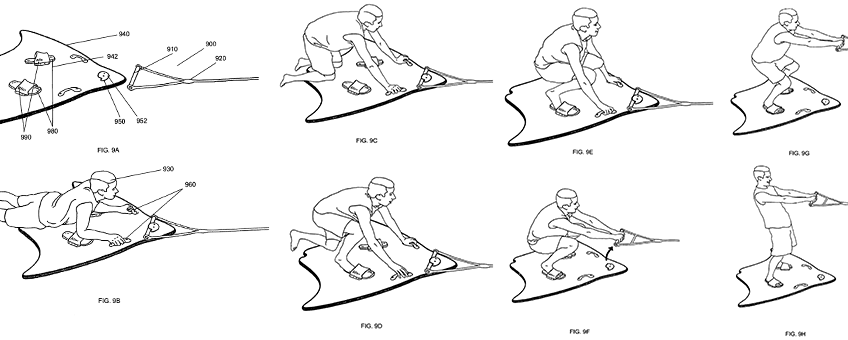
patent drawings for ZUP water recreation device

ZUP v Nash Manufacturing

ZUP, LLC v. Nash Manufacturing, Inc.

No. 2017-1601  Fed. Cir. July 25, 2018
Opinion by Chief Judge Prost with Circuit Judge Lourie.
Dissenting opinion filed by Circuit Judge Newman.

The United States Court of Appeals for the Federal Circuit (“Federal Circuit”) affirmed the decision of the district court invalidating claims of U.S. Patent No. 8,292,681 (“the ’681 patent”) as obvious. The issues on appeal pertained to (1) motivation to combine the prior art references in the way claimed in the ’681 patent, and (2) the district court’s evaluation of evidence of secondary considerations.

The claims of the ’681 patent cover a water recreational board and a method of riding the board. A rider simultaneously uses side-by-side handles and side-byside foot bindings to help maneuver between various riding positions. The board assists riders who have difficulty pulling themselves into a standing position while being towed behind a motorboat.

Chief Judge Prost, writing for the majority, stated that because of “significant evidence presented by Nash regarding the consistent desire for riders to change positions while riding water recreational boards (and the need to maintain stability while doing so), and given that the elements of the ’681 patent were used in the prior art for this very purpose, there is no genuine dispute as to the existence of a motivation to combine.”

Nash introduced no evidence concerning secondary considerations, while ZUP submitted two affidavits demonstrating secondary considerations. The Court acknowledged that the burden of persuasion was on the challenger (Nash), but stated that “a patentee bears the burden of production with respect to evidence of secondary considerations of non-obviousness.” As a result, it was not necessary for Nash to present evidence of secondary considerations to obtain summary judgment. The Court noted that obviousness is “a legal determination, and a strong showing of obviousness may stand even in the face of considerable evidence of secondary  considerations.”

The Court noted that obviousness is “a legal determination, and a strong showing of obviousness may stand even in the face of considerable evidence of secondary  considerations.”

In an attempt to show long-felt but unresolved need, ZUP proffered expert testimony stating that the water sports market had long focused on creating stability for a rider and that “it was a general frustration to the industry that there was no product that would enable the weakest and most athletically challenged members of the boating community to ski or wakeboard.” Further, Nash’s president, during negotiations stated “You have a great product by the way!” and that ZUP was “spot on” with its product. The Court dismissed the argument, finding that since differences between the prior art and the claimed invention were minimal, no long-felt need was solved.

Nash had obtained a sample product from ZUP during the parties’ initial business discussions. The Court rejected ZUP’s position that Nash copied the product, stating that for the Nash board “to resemble the claimed invention, a user would need to ignore Nash’s instructions on how to use the (Nash) Versa Board — instructions that specifically discourage users from keeping the handles attached to the board while standing.”

Judge Newman dissented, stating that the majority reached its conclusion based “on incorrect application of the law of obviousness and without regard to the principles of summary judgment.” Judge Newman stated that all agreed that the ZUP invention was novel, but that “the district court and my colleagues hold that because some prior art wakeboards have handles and some have foot supports, nothing more is needed for summary judgment of obviousness.”

In the dissent’s view, the majority deemed “that only three of the four Graham factors are considered in order to establish a prima facie case of obviousness, and that the fourth Graham factor is applied only in rebuttal, whereby the fourth factor must be of sufficient weight to outweigh and thereby rebut the first three factors.” Judge Newnan stated that the fourth Graham factor, objective indicia of secondary considerations, “must be considered together with the other evidence, and not separated out and required to outweigh or rebut the other factors.” She went on to note the importance of objective indicia in overcoming hindsight, noting that neither the lower court nor the majority identified any suggestion in the prior art to make the modifications presented by the claimed invention, stating that “the only source of these modifications is judicial hindsight.”

The dissent also posited that the district court misapplied the factor of long-felt need. “Motivation to solve a known problem is not motivation to make a specific solution.” “(The inventor’s) realignment of known elements in a crowded field, achieving benefits not previously achieved, weighs against obviousness.”

With regard to copying, Nash possessed the ZUP product prior to producing its product. The majority indicated that because ZUP did not give Nash a “blueprint,” evidence of copying is diminished. However, Judge Newman replied that “[n]o precedent, no logic, requires a ‘blueprint’ in order to copy a simple structure in plain view and possessed by the accused infringer.”

Read more: Federal Bar member attorneys may access the full case summary by registered patent attorney B.C. “Bill” Killough in the August 2018 issue of Federal Circuit Case Digest.

headshot of B.C. Killough B.C. Killough is a registered patent attorney based in Charleston, SC. On behalf of his clients, Bill has obtained more than 300 United States patents, participated in prosecuting more than 100 foreign patent applications and he has filed more than 1000 trademark applications with the US Patent and Trademark Offices.

Additionally, you may read the full opinion here.  



businessman selecting patent on clear touch screen

Zeroclick v Apple

ZEROCLICK, LLC, Plaintiff-Appellant  v. APPLE INC., Defendant-Appellee

2017-1267

The Federal Circuit found that the district court had failed to undertake a relevant inquiry and make related factual findings to support its conclusion that the asserted claims recited means-plus- function terms.  The Federal Circuit vacated and remanded the district court’s judgment.

The patents-in-suit relate to modifications to graphical user interfaces that allow the interfaces to be controlled using pre-defined pointer or touch movements instead of mouse clicks by using a two-step method or by making two configuration changes to the user interface code. (more…)

businessman selecting patent on clear touch screen

D Three v Sunmodo Corp

D THREE ENTERPRISES, LLC, Plaintiff-Appellant v. SUNMODO CORPORATION, Defendant-Appellee

2017-1909, 2017-1910
Decided: May 21, 2018

The district court granted summary judgment in favor of appellees based on a determination that D Three could not claim priority from a provisional application filed February 9, 2009 (“2009 Application”). The priority claim was necessary to D Three’s case, since it was undisputed that the appellees’ allegedly infringing products were available to the public prior to the effective filing dates of the utility applications upon which the infringement claims were based. The Court affirmed, finding that the 2009 Application did not meet the written description requirement of 35 U.S.C. § 112(a). (more…)

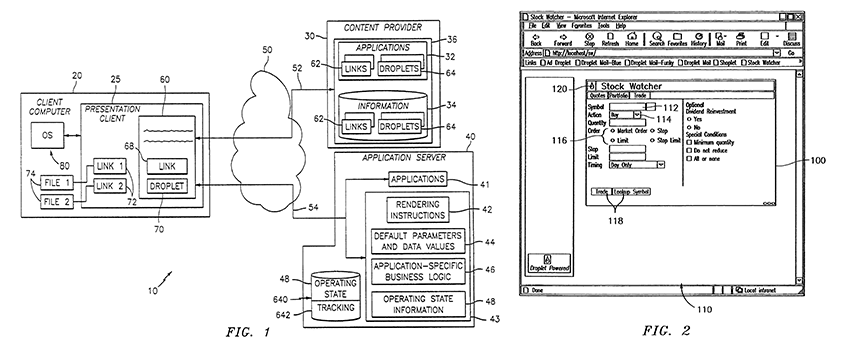
incomplete patent drawings for Droplets case

Droplets v E*TRADE Bank

Droplets, Inc., v. E*TRADE Bank

Nos. 2016-2504,-2602 Fed. Cir. Apr. 19, 2018 Opinion by Judge O’Malley with Circuit Judges Dyk and Wallach.

This appeal arises from a finding by the Patent Trial and Appeal Board (“the Board”) that all claims of U.S. Patent No. 8,402,115 (“the Patent”), owned by Droplets, Inc. (“Droplets”), are invalid as obvious under 35 U.S.C. § 103. The issue on appeal is the sufficiency of a priority claim incorporated by reference to avoid invalidating prior art. The United States Court of Appeals for the Federal Circuit (“Federal Circuit”) affirmed the Board’s finding of invalidity. (more…)

legal gavel with pharmaceuticals

Merck Sharp Dohme v Amneal Pharmaceuticals

Merck Sharp & Dohme Corp., v. Amneal Pharmaceuticals LLC

No. 2017-1560 Fed. Cir. Feb. 9 2018 Opinion by Circuit Judge Stoll with Circuit Judges Taranto and Clevenger.

Merck filed an infringement suit alleging that, if approved by the FDA, Amneal’s proposed Abbreviated New Drug Application (“ANDA”) product would infringe U.S.Patent No. 6,127,353. Following a bench trial, the district court found that Merck failed to prove by preponderant evidence that Amneal’s ANDA product would infringe the patent. The United States Court of Appeals for the Federal Circuit (“Federal Circuit”) affirmed the district court. (more…)

patent circuit board

AVC v HTC BLACKBERRY MOTOROLA

ADVANCED VIDEO TECHNOLOGIES LLC, v. HTC CORPORATION, HTC AMERICA, INC., BLACKBERRY LTD, BLACKBERRY CORPORATION, MOTOROLA MOBILITY LLC, Defendants-Appellees

Federal Circuit law requires that all owners of a patent must be parties to an infringement action. In this case, the Court determined that Ms. Hsuin was a co-inventor of US Patent No. 5,781,788 and that the terms of an employment agreement were ineffective to transfer her interests to the Appellant. The Court affirmed the district court’s dismissal of the case due to plaintiff’s lack of standing. (more…)

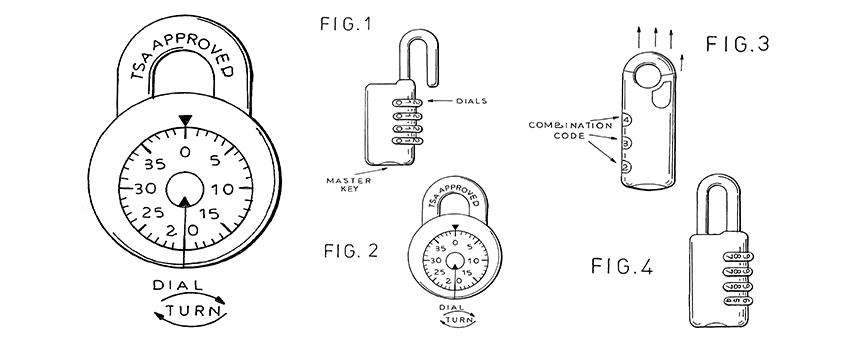
patent art for travel locks in travel sentry v tropp patent infringement case

Travel Sentry v David Tropp

TRAVEL SENTRY, INC.,  Plaintiff-Cross-Appellant v. DAVID A. TROPP, Defendant-Appellant

2016-2386, 2016-2387, 2016-2714, 2017-1025  Appeals from the United States District Court for the Eastern District of New York in Nos. 1:06-cv-06415-ENV- RLM, 1:08-cv-04446-ENV-RLM, Judge Eric N. Vitaliano.

For the third time, the Court presided over this dispute regarding whether Travel Sentry, Inc. (“Travel Sentry”) and its licensees infringed one or more claims of two patents issued to appellant David A. Tropp (“Tropp”).  In this iteration, the Court reversed the district court’s entry of summary judgment that Travel Sentry and its licensees did not directly infringe any of the method claims recited in the patents under 35 U.S.C. § 271(a).

This case closely tracked the developments of, and presented similar issues to, another well-traveled case, Akamai Technologies, Inc. v. Limelight Networks, Inc., which the Court discussed at length in this opinion.  Akamai examined the respective scopes of divided and induced infringement. (more…)

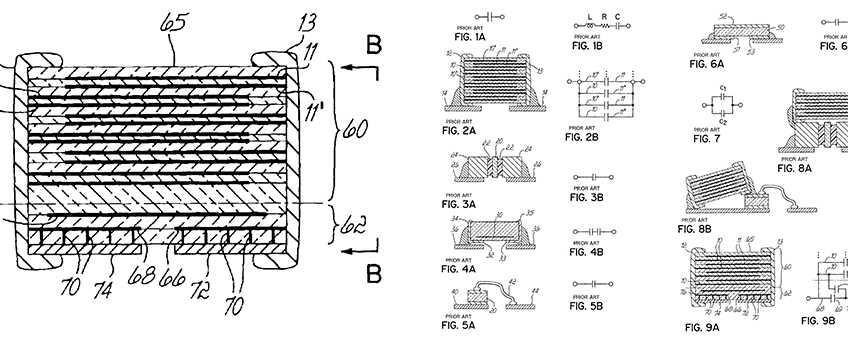
Partial patent art for US Patent 6,816,356

Presidio v American Technical Ceramics

PRESIDIO COMPONENTS, INC. v. AMERICAN TECHNICAL CERAMICS CORP.

2016-2607, 2016-2650

Presidio filed suit against American Technical Ceramics Corp. (“ATC”) for patent infringement. The Federal Circuit affirmed the district court’s holdings that the claims of the patent are not indefinite and that ATC is entitled to absolute intervening rights because a substantive amendment was made during reexamination. The Federal Circuit reversed the award of lost profits and remanded for determination of a reasonable royalty, while concluding that the district court did not abuse its discretion in declining to award enhanced damages. The Federal Circuit vacated the district court’s issuance of permanent injunction. (more…)

businessman selecting patent on clear touch screen

Organik Kimya v Rohm and Haas

Organik Kimya AS v. Rohm And Haas Co. Nos. 2015-1983, -2001 Fed. Cir. Oct. 11, 2017

Opinion by Circuit Judge Newman with Chief Judge Prost and Circuit Judge Taranto

Organik appeals the decisions of the PTAB in two IPR proceedings. The PTAB sustained the patentability of claims U.S Patent No. 6,020,435 (“the ’435 Patent”) and claims of its division, U.S. Patent No. 6,252,004 (“the ’004 Patent”). The United States Court of Appeals for the Federal Circuit (Federal Circuit) affirmed in an opinion written by Judge Newman.

The ’435 Patent and the ’004 Patent are directed to processes for preparing emulsion polymers having improved opacity. Improved opacity is the result of voids (hollows) produced within the polymer particles. A base swelling agent and excess monomer are introduced into an aqueous emulsion of the polymer, with no substantial polymerization. The base permeates the outer shell of the polymer particle and neutralizes the acid core. The resulting hydrophilic salt in the core promotes diffusion of water, swelling the polymer particle. Evaporation of the water leaves an enlarged hollow core. Suitable swelling agents include fixed or permanent bases such as potassium hydroxide.  Proceedings were instituted on grounds of anticipation and obviousness. (more…)

Waymo, Uber and Otto logos

Waymo v Uber, Ottomotto

Waymo LLC, v. Uber Technologies, Inc., Ottomotto LLC, Otto Trucking LLC

Nos. 2017-2235, -2253 Fed. Cir. Sept. 13, 2017 Opinion by Circuit Judge Wallach with Circuit Judges Newman and Stoll

Appellant Anthony Levandowski intervened seeking to prevent discovery sought by Appellee Waymo LLC (“Waymo”) in its lawsuit against Uber Technologies, Inc. (“Uber”). Waymo alleged that Mr. Levandowski, its former employee, improperly downloaded documents and then left Waymo to create Ottomotto, which Uber subsequently acquired. Before the acquisition closed, counsel for Ottomotto and Uber (but not counsel for Mr. Levandowski) jointly retained a firm to investigate Ottomotto employees that were previously employed by Waymo, including Mr. Levandowski. That report (“the Stroz Report”) was the subject of the discovery dispute before the court on appeal. (more…)