businessman protecting graphic of human brain in his hands

ATI Tech ULC v Iancu

ATI Technologies ULC v. Iancu

Nos. 2016-2222, 2016-2406, 2016-2608 Fed. Cir. April 11, 2019 Before Circuit Judges Newman, O’Malley, and Wallach.

ATI Technologies ULC (“ATI”) appeals three final decisions of the Patent Trial and Appeal Board (“PTAB” or “Board”) on petitions for inter partes review filed by LG Electronics, Inc. (“LGE”). The Board held all but one of the challenged claims unpatentable as anticipated or obvious. LGE withdrew from its appeal and cross-appeal, and the PTO Director intervened in support of the PTAB decisions.

This case arises under the pre-AIA “first to invent” statutory scheme. ATI filed Rule 131 declarations to “swear behind” prior art references. The PTAB held that conception was established before the primary reference dates, and that constructive reduction to practice occurred on the filing date of each patent. However, the PTAB held that ATI had not established actual reduction to practice or diligence to constructive reduction to practice for the three patents. The PTAB therefore invalidated the patents based on the cited references. The Federal Circuit reversed, finding that ATI exercised (more…)


wooden dice spelling obvious

TEK Global v Sealant Systems Intl

TEK Global, S.R.L., TEK Corporation v. Sealant Systems
International, Inc., ITW Global Tire Repair

No. 2017-2507 Fed. Cir. April 2, 2019 Before Chief Judge Prost, with Circuit Judges Dyk and Wallach.

The patent in suit is directed to an emergency kit for repairing vehicle tires deflated by puncture. The Court held that Appellant should not have been prevented from presenting to the jury theories concerning obviousness that Appellant had not asserted in a prior appeal to the Federal Circuit, even though the Court considered the same prior art references in the prior appeal. The Court remanded the case for a partial new trial on validity.

Appellant SSI argued that “conduits connecting the container” and “container connecting conduit” should be construed as means-plus-function limitations under 35 U.S.C. § 112, ¶ 6 because the term “conduit” is a nonce word. After reviewing the claim language (including dependent claims), the specification, the prosecution history, and dictionaries, the Court concluded that intrinsic and extrinsic evidence established that the term “conduit” sufficiently defines a structure so as to avoid classification as a nonce term. (more…)

tablet dissolving in water with stopwatch marking 30 seconds

Forest Labs v Sigmapharm Labs

Forest Laboratories, LLC, et al. v. Sigmapharm Laboratories, LLC., et al.

Nos. 2017-2369, etc. Fed. Cir. March 14, 2019 Before Chief Judge Prost, with Circuit Judges Dyk and Moore. Opinion by Circuit Judge Moore.

Sigmapharm filed an Abbreviated New Drug Application seeking to market generic versions of Saphris, a sublingually administered, atypical antipsychotic containing asenapine maleate. Claim 1 claimed a solid pharmaceutical composition that disintegrated within 30 seconds in water at 37ºC. Claim 1 did not expressly refer to buccal or sublingual administration. The district court construed claim 1 to be limited to buccal and sublingual formulations and that the claims were not obvious.

Although the Federal Circuit agreed with the district court’s claim construction, the Court vacated the district court’s judgment of non-obviousness and remanded the district court’s judgment. (more…)

patent circuit board

Personal Web Tech v Apple

Appeal from the United States Patent and Trademark Office, Patent Trial and Appeal Board

Personal Web Technologies, LLC v. Apple, Inc.
No. 2018-1599 Fed. Cir. March 8, 2019 Before Circuit Judges Moore, Taranto, and Chen. Opinion by Circuit Judge Chen.

The Court reversed the Board’s determination that certain claims of U.S. Patent No. 7,802,310 were obvious because key underlying fact findings by the Board were not supported by substantial evidence.

The patent at issue contemplates a method and apparatus for creating a substantially unique identifier for each data item in a data processing system that is independent of the data item’s user-defined name, location, etc., but rather is dependent only on the content of the data item itself. The patent purports to overcome problems associated with traditional naming conventions, such as when a data item already exists a device and a duplicate of the data item is created. (more…)

patent art for parking meters

Duncan Parking Tech v IPS Group

Patent and Trademark Appeal Case Summary

Duncan Parking Technologies, Inc. v. IPS Group, Inc.
No. 2018-1205 Federal Circuit Judges Lourie, Dyk, and Taranto.

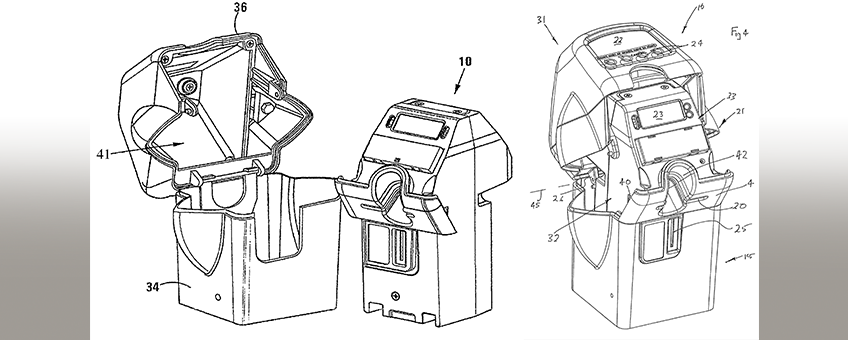
IPS Group Inc. (“IPS”) appealed from two district court decisions granting summary judgment of noninfringement of U.S. Patents 8,595,054 (“the ’054 patent”) and 7,854,310 (“the ’310 patent). Duncan Parking Technologies Inc. (“DPT”) appealed from a related decision of the PTAB holding that claims of the ’310 patent were not unpatentable as anticipated under 35 U.S.C.§102(e). The Court reversed the Board’s decision with regard to ’310 patent; affirmed the district court’s decision granting summary judgment of noninfringement of the ’310 patent; and vacated the district court’s decision in granting summary judgment of noninfringement of the ’054 patent because the district court erred in construing its claims too narrowly. (more…)

lettered dice stacked spelling the word patent

No dice Marco Guldenaar Holding BV

In re: Marco Guldenaar Holding B.V.

No. 2017-2465 Fed. Cir. Dec. 28, 2018 Before Circuit Judges Chen, Mayer, and Bryson. Opinion by Circuit Judge Chen.  Concurring opinion by Circuit Judge Mayer.

This case came before the Court on appeal from the decision of the Patent Trial and Appeal Board (Board) affirming the rejection of claims under 35 U.S.C. § 101 directed to the abstract idea of rules for playing a dice game. Finding that “the only arguable inventive concept relates to the dice markings,” the Court affirmed the Board.

The majority stated that patent eligibility under 35 U.S.C. § 101 is a question of law that may contain underlying issues of fact. Reiterating that laws of nature, natural phenomena, and abstract ideas are not patentable, the majority found that the claims were directed to an abstract idea, citing In re Smith, 815 F.3d 816 (Fed. Cir. 2016). In Smith, which involved a method of conducting a wagering game using cards, the Court agreed that the phrase “methods of organizing human activities” can be confusing and potentially misused in an abstract idea analysis, but found the claims in issue were directed to an abstract idea. (more…)

businessman cradling computer graphic of brain and computer circuits in his hands

Acceleration Bay v Activision Blizzard

ACCELERATION BAY, LLC, Appellant v. ACTIVISION BLIZZARD INC., ELECTRONIC ARTS INC., TAKE-TWO INTERACTIVE SOFTWARE, INC., 2K SPORTS, INC., ROCKSTAR GAMES, INC.,Cross-Appellants
BUNGIE, INC., Appellee

Nos. 2017-2084, 2017-2085, 2017-2095, 2017-2096, 2017- 2097, 2017-2098, 2017-2099, 2017-2117, 2017-2118 Fed. Cir. Nov. 6, 2018
Opinion by Circuit Judge Moore with Chief Judge Prost and Circuit Judge Reyna.

Blizzard filed six inter partes review (“IPR”) petitions. Each petition covered one of three Acceleration patents, but were based principally on two different prior art references. One set of IPRs challenged claims based on a Shoubridge article alone or combined with a prior art book, and the other set of IPRs challenged claims based on a Lin article alone or combined with another reference. The Board determined that certain claims of the three patents were invalid in view of the Shoubridge article. The Board also determined that the Lin article was not a printed publication under 35 U.S.C. § 102(a). Acceleration appealed portions of the Board’s decisions, and Blizzard cross-appealed. The Federal Circuit affirmed the holdings of the Board. (more…)

image of numbers 0-6 lined up like dominos

Natural Alternatives Intl v Iancu

Natural Alternatives International v. Iancu

No. 2017-1962 Fed. Cir. Oct. 1, 2018 Opinion by Chief Judge Prost with Circuit Judges Moore and Reyna.

Natural Alternatives International, Inc. (“NAI”) filed a chain of eight U.S. patent applications, with each claiming priority under 35 U.S.C. § 120 back to the filing date of the first application. The eighth application became U.S. Patent No. 8,067,381 (“the ‘381 patent”). After challenge by a third party, the USPTO ordered inter partes reexamination. The examiner rejected the challenged claims as anticipated by or obvious over cited prior art (including a parent of the reexamined patent). The Patent Trial and Appeal Board affirmed.

The issue in the case relates to the priority claim in the eighth application. At the time NAI filed the sixth application, it correctly claimed priority to the fifth application. The fifth application correctly claimed priority to applications one through four. While the fifth application was pending, priority to the fourth through first applications (plus a provisional application) was deleted in order to gain patent term. The Board therefore determined that the fifth application was not entitled to the benefit of the fourth application. Because the eighth application claimed priority to the first application through the fifth application, the eighth application was not entitled to the benefit of applications one through four. (more…)

wooden dice spelling obvious

USC v Broad MIT Harvard

REGENTS OF THE UNIVERSITY OF CALIFORNIA, UNIVERSITY OF VIENNA, EMMANUELLE CHARPENTIER, Appellants v. BROAD INSTITUTE, INC., MASSACHUSETTS INSTITUTE OF TECHNOLOGY, PRESIDENT AND FELLOWS OF HARVARD COLLEGE, Appellees

No. 2017-1907 Fed. Cir. Sept. 10, 2018 Opinion by Circuit Judge Moore with Chief Judge Prost and Circuit Judge Schall.

This is an appeal from a decision of the PTAB (“Board”) in an interference, a soon to be obsolete proceeding. The PTAB determined there was no interference-in-fact between the claims of Appellants’ patent application and the claims of twelve patents and one application owned by Appellees. The issue in the case was whether “the subject matter of a claim of one party would, if prior art, have anticipated or rendered obvious the subject matter of a claim of the opposing party and vice versa.” See 37 C.F.R. § 41.203(a). The Court noted that “[w]hen an interference-in-fact turns on whether one set of claims renders obvious the subject matter of another set of claims, the standard of review mirrors that in an obviousness review” and that “[o]bviousness is a question of law based on underlying facts.” The Court found that substantial evidence supported the Board’s fact-finding of a lack of reasonable expectation of success, and affirmed the Board’s determination that there was no interference-in-fact.

The case is instructive in the Court’s commentary on the Board’s obviousness determination. (more…)

black and white images of ying and yang and a tea pot with steaming tea cup

Tai Chi Green Tea v Diamond Hong

ZHENG CAI, DBA TAI CHI GREEN TEA INC., Appellant v. DIAMOND HONG, INC., Appellee

2018-1688 Decided: August 27, 2018

The Trademark Trial and Appeal Board (“TTAB”) canceled the registration of mark “WU DANG TAI CHI GREEN TEA” due to a likelihood of confusion pursuant to 15 U.S.C. § 1052(d) with Diamond Hong, Inc.’s (“Diamond Hong”) registered mark, “TAI CHI.” Zheng Cai (“Mr. Cai”), appearing pro se, appealed the TTAB’s exclusion of evidence from his main brief and its finding of likelihood of confusion. The Federal Circuit affirmed.

The Court held that the “TTAB did not abuse its discretion in determining that Mr. Cai submitted no evidence.” The TTAB disregarded factual assertions in Mr. Cai’s brief, which the Court stated were “not evidence under any of the relevant rules”. (more…)